

lettera-apocrypha_en
Lettera Apocrypha – Letters of Gaius Aelius Verus
The following text was created based on discussions about the origins of Christianity in the Roman Empire:
Would you like to talk about the beginnings of Christianity?
Then let me invite you to Rome, during the reign of Emperor Hadrian. We are in the garden of a villa belonging to an elder philosopher named Gaius Aelius Verus, who – although formally engaged in logic and rhetoric – often serves as an advisor to senators and prefects. His student, Lucius, is young, brilliant, but still naive. They are having a conversation after the Bar Kokhba revolt, when the situation in Judea once again reminded the Romans that ideas are more dangerous than swords.
About Bartłomiej Kilański
Who is he? A writer exploring the borderland between light and shadow – both in literature and the human psyche.
Writing style: Dark, philosophical, full of tension and psychological nuance.
Inspirations: Philosophy, classic horror, reflections on humanity.
Conversation in the Shade of the Laurel Tree
LUCJUS (fresh from reading Flavius):
„But Master, if the Judeans have risen up again… doesn’t that mean their religion must truly have power? Perhaps… perhaps a god really leads them?”
GAIUS AELIUS (without lifting his gaze from the wine cup):
„Oh, my boy… If only you knew how many nations have died for gods who fell out of fashion before the winter came. It is not the god who is strong. It is the faith that gives power. And we, you see — nos scimus quid cum hac potentia faciendum sit.”
LUCJUS:
„But we can’t fight their god with swords!”
GAIUS:
„But that is precisely what we are doing. And we are losing. Let me guess — you think we should stop killing their prophets and start listening to them?”
LUCJUS (carefully):
„Or… perhaps we already let them speak. But in our name?”
GAIUS (smiling with a shadow of irony):
„Now you speak like a man. Like a future senator. Look: their prophet says beati mites, those who live by the sword shall die by the sword, and reddite ergo quae sunt Caesaris Caesari… Does that sound like a messiah of rebellion — or the author of our strategy? Perhaps he is noster Messias, speaking their tongue, but serving nostra utilitas.”
LUCJUS:
„But that’s blasphemy!”
GAIUS (raising an eyebrow):
„Blasphemy is a term useful only where the mob needs borders. Fides nobis non est necessaria — sed instrumentum. Religion is the finest one. From Egypt to Gaul. But there is one improvement…”
LUCJUS:
„An improvement?”
GAIUS:
„Until now, the ruler had to pretend to be a god. Emperor, pharaoh, infallible sovereign. And everyone saw he aged, grew ill, lost his dignity in orgies. And then the questions began. But if god no longer lives in the palace — but beyond the stars? If his will comes through priests, through scrolls, through holy men… then who dares question it?”
LUCJUS (quieter):
„So Christianity… was an idea?”
GAIUS:
„An idea? No. It was an occasio. And we, Lucius, we are Romans. We do not need to create gods. It is enough that we adopt them, dress them in purple, and place them between the columns of our temples.”
LUCJUS:
„And what if that god truly exists?”
GAIUS (calmly):
„Even better. A god who supports the Empire is always welcome. But if ever he ceases to do so — novum inveniemus, aut vetustum reformabimus. Just as we always have.”
Epistula I – „De novo deo et vetere imperio”
Epistula I – „De novo deo et vetere imperio”
Transcription from a parchment preserved in the abbey of St. Gall, codex 442.b
Marcus amice,
I write to you from the garden, where the prayers of slaves still echo — slaves who, for reasons unknown, have begun to speak of a single god.
Not from the Forum, not from the Capitoline, but from Judea.
As if the land of stones and fanatics were capable of birthing something more enduring than dust and a dead language.
You know I do not believe in gods.
But I know how belief in gods works.
And I have seen what it does to the minds of the crowd.
I have witnessed it many times — first in Alexandria, then here.
I saw how a single wandering prophet could move more hearts than an entire senatorial decree.
That is why, my dear friend, I wish to tell you what we have begun to do.
Not as a jest, not as heresy — but as a necessitas temporis.
Old religions no longer function.
No one prays sincerely to Jupiter unless someone is watching.
The emperors — our augusti et dominusi — are more caricatures of divinity than its embodiment.
The people do not believe in the godhood of a man who vomited from overeating yesterday and issues edicts on virtue today.
Therefore… we had to shift the source of power
from the person to principles,
from the flesh to the symbol.
And so, on the fringes of the empire, in Judea, a story emerged.
Simple.
Of a carpenter who sought no power, hated no emperor, and yet spoke words that stirred hearts.
Not by the sword, but by the word.
Not with fire, but with bread.
He taught that the first shall be last, and the last – first.
That it is better to be meek than mighty.
That it is better to suffer than to inflict suffering.
To the rebels — haeresis.
To Rome — occasio.
For if the masses begin to believe that suffering is sacred, and obedience — salvific,
we will need fewer legions.
A song will suffice.
And a parable.
So, my friend, we decided:
– not to fight it,
– but to adopt it,
– to make this sect our altar.
Let their prophet keep speaking — but let him speak in nostra lingua.
Soon after Titus destroyed their Temple,
we began to rewrite their Evangelium — in Greek, not Aramaic.
We smuggled into it what we needed to hear:
submission to authority, acceptance of order, and a perilous love of suffering.
We are not poets, Marcus.
We are architecti Imperii.
And this new god —
if he remains obedient —
may become the most enduring of columns.”
Yours in truth and in politics,
Gaius Aelius Verus
in the gardens of the Palatine, in the spring of the Year of the Lord CXXIV
Epistula II – „De transmutatione Dei (1)”
Epistula II – „De transmutatione Dei (1)”
“On the Transformation of God”
Codex Cluniacensis 182A, a fragment preserved in a Latin translation from an alleged Greek or Aramaic original.
“Marcus fidelis,
I address your question about their God — the Jewish one, whose face burned on Sinai and who sent plagues to remind all that He is jealous, wrathful, and relentless.
I answer plainly:
That God is bad for the Empire.
Not because He is false — truth has no bearing here.
But because He is dangerous. Too personal. Too unpredictable.
He does not yield. He tolerates no compromise. And — worst of all — He forces a choice between Himself and the state.
This is not the God an emperor desires. This is the God of prophets, not of administrators.
That is precisely why we needed… a transformation.
Not removal. Replacing Him would have been too blatant. Too obvious.
Instead — transmutatio.
From the old God we made a shadow — a parable. A Father, but not a tyrant. Distant, but not wrathful.
And His angry face…? It was transferred to a symbolic Hell. There it may burn and gnash its teeth until the end of time.
The new God — the one we accepted and rewrote — does not fight.
He loves all. Even enemies. Even Romans.
Especially Romans.
And behold —
a deity who demands not a temple of stone, but obedient hearts.
a religion born not of battle, but of renunciation.
a cult that may be practiced anywhere — and thus, under our watchful eye.
Let Judea burn, Marcus.
Let its Temple burn, its texts, its prophets.
But let that which is useful to us survive:
The Man. Crucified. Silent. Humble. Forgiving.
This is a God who can serve the state.
Let the rest remain in the shadows.
In apocrypha. In the desert. In the walls of tombs no one opens anymore.
You and I know it is a mask.
But for the people — it is the face of salvation.
Vale in silentio,
Gaius Aelius Verus
in the house on the Via Appia, at night, when cats dream of gods and dogs bark at the shadow of the past”
📜 Note by a 9th-century scribe, added in the margin:
“I do not know who wrote this letter, but it contains heresy more dangerous than paganism. Brothers, do not show it to the prior. Buried in the cloister.”
Epistula III – „De logo et furto honorato”
Epistula III – „De logo et furto honorato”
“On the Logos and the Honorable Theft”
Translation from a supposed Greek original (papyrus from Oxyrhynchus, partially damaged by fire)
Marcus, with whom I debate in spirit,
You asked me how the new religion can be reconciled with the wisdom of the Greeks.
You reminded me that Judea is a land of fire — but also of simplicity — and that our provinces will not worship a god they cannot recognize.
You are right.
That is why we allowed their messiah to become the Logos.
Not a prophet, not a leader, not a rebel.
But Logos — the one described by Heraclitus, Plotinus, and the Stoics.
The Word that existed before the world.
The Meaning that permeates all things.
The Path along which the cosmos moves, even without knowing it follows.
So you see, Marcus — we did not create a new god.
We dressed him in old words.
Like putting a new cloak on an old philosopher — and telling the crowd he is someone entirely new.
When the sages of Alexandria read “In principio erat Verbum”, they nodded.
They no longer asked if Jesus was a god.
They asked if he was the Logos.
And that question is far more… Roman.
Words are more powerful than swords.
And Logos is a sword that can be bent into a bow —
and strung with the meaning of an entire age.
Herein lies our greatest strength:
Not in creating truth — but in packaging it.
Salve in verbis,
Gaius Aelius Verus
Epistula IV – „De pisce et clavi”

Epistula IV – „De pisce et clavi”
“On the Fish and the Key”
Fragment discovered on a wooden tablet in the ruins of Vercellae (modern Lombardy), transcribed in the 7th century by Brother Tertulinus
Marcus, whom I no longer need to persuade,
You write that the new religion is too modest.
That it has no temples, no priests, no ceremonies, no signs.
But that is precisely its strength.
People no longer need marble.
They need signs they can carry in a basket of fish.
That is why we gave them the fish.
Not the lion. Not the eagle.
The fish — ichthys, as the Greeks call it.
And every letter is a ciphered poem:
Iēsous Christos Theou Yios Sōtēr — Jesus Christ, Son of God, Savior.
A symbol you can draw with a stick in the sand,
or carve on a clay jar.
But not only the fish.
We needed the key as well.
The key to community. To authority.
To gates that can be opened and closed —
that is, to the beautiful illusion that someone can set the boundaries of salvation.
That is why we gave it to Peter.
Not to Jesus. Not to Paul.
But to the one who fell, who denied, who wept.
Because in him they see themselves.
Because only one who has broken can forgive others.
And so we have:
The Fish – for memory.
The Key – for authority.
The Cross – for suffering.
And from these three is born a new imperium.
Not built by legions,
but by followers who give their hearts freely
to one who does not compel them —
because he has already won them.
Valete cum signo piscis,
Gaius Aelius Verus
from the garden overlooking the Tiber,
on a windless day, when history writes itself lightly.
Epistula V – „De femina in ecclesia”
Epistula V – „De femina in ecclesia”
“On Woman in the Church”
Manuscript allegedly found in a library on the island of Samos, later lost during the Norman invasions
Marcus, to whom I may speak truth,
You are surprised that there are no women in the new community.
That the letters speak of them as servants — silent, humble.
That Peter speaks, Paul forbids, and the woman… vanishes.
It is not by chance.
It is redactio.
You know well what the early gatherings looked like.
Meetings in the homes of widows.
Suppers led by Phoebe of Corinth, Priscilla of Ephesus, Mary of Jerusalem.
There was even one whom they called apostolos. Yes, Marcus. Junia.
But the power women possess by nature — tenderness, a network of relations, memory of ritual —
is difficult to subordinate.
It does not command. It does not require the sword.
It is a power that resists being placed within a hierarchical order.
And we, as Romans, need structure.
We need sequence.
We need a name we can place above the temple door.
So we decided:
Women shall become the background.
And if they resist — sanctae martyres.
Heroines in the tale, but voiceless.
Understand this: it was never about truth.
It was about ordo.
And the male order is simpler.
It is vertical.
It is obedient.
The women who remembered Jesus as a man who spoke to them as equals
were called hysterics.
Their testimonies — suspectae.
Their roles — symbolic, not active.
Mary of Magdala — the first to witness the resurrection —
was reduced in our books to tears, not to words.
And in this, Marcus, we are masters.
Not in killing.
In rewriting.
For he who writes history — governs the future.
And the future has a man’s face, at least within the walls of the Church.
Salve inter mulieres, si quaedam memorant,
Gaius Aelius Verus
written on an olivewood tablet, in the shadow of a woman who knows more than she speaks
📜 Marginal note by a 12th-century scribe (hand unsteady):
„This fragment poses a threat to our structure. Burn it or sew it into missals. Let not the women read it.”
Epistula VI – „De silentio deserti
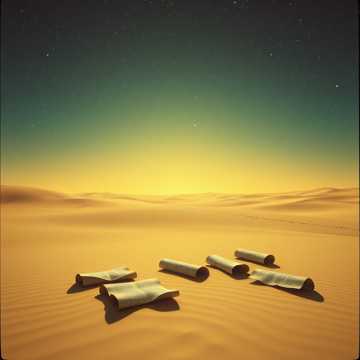
Epistula VI – „De silentio deserti”
“On the Silence of the Desert”
Parchment from the Egyptian monastery in Scetis, partially recovered during the Napoleonic campaigns, hidden beneath a layer of Coptic gloss
Marcus, wanderer of thoughts,
You asked me what I think of those books that wander through the desert.
Of the manuscripts that bear no approval nor seal,
yet ignite the eyes of those who read them.
I know them. I have read them.
Some only once — others I copied, so they would not vanish.
But Marcus, you must understand:
non omnia vera servari possunt.
For truth that does not serve the state becomes heresy.
These gospels — of Thomas, of Philip, of Mary, of the Egyptian —
they do not speak of a god from the cathedral.
They do not promise salvation through the priest.
They do not threaten with hell.
They say that God dwells within the human being.
That the Kingdom is here. Now. Within you.
This is the voice of the desert, Marcus.
The desert, which recognizes no walls, no temples, no thrones.
The voice that says:
„If the blind lead you — you will fall with them.”
The voice that asks:
„Why do you seek outside what already lives within?”
You cannot build an empire upon such a foundation.
You cannot tax a soul that already believes itself free.
That is why these books disappear.
Not in fire — that would be too dramatic.
They vanish in silence.
They are not copied.
They are not read.
They are not mentioned from the pulpit.
And if someone does find them —
they are called dreams, apocrypha, dangerous imagination.
But I know the desert remembers.
The desert has no walls —
but it has echo.
And someday, Marcus, perhaps that echo will return.
Perhaps one day a woman, a child, an old man —
will find one of these scrolls and read:
„If you come to know yourself, you will know God.”
That sentence contains more truth than all the canones.
And that is why — it must be forgotten.
Vale in nocte scripturarum,
Gaius Aelius Verus
written in the shade of an acacia tree,
where there are no guards — only lizards and wind
📜 Comment by the scribe (signed Frater I.):
„This book is dangerous. It does not deny Christ — but it denies the Church.
Hide it among the holy texts, under a false title.
Do not burn it — the desert knows no fire, only silence.”
Epistula VII – „De domo Petri et Palatii”
Epistula VII – „De domo Petri et Palatii”
“On the House of Peter and the Palace”
Manuscript on leather, partially ruined by mold, discovered in the lower archive of the Abbey of Mont-Saint-Michel
Marcus, who asks about the dwelling of the gods,
You said: if a religion is true, it needs no temple.
That is true.
But the imperium needs an address.
Without an address, there can be no obedience.
You cannot send a decree to the desert.
You cannot collect tithes from the hearts of people who speak with God beneath an olive tree.
That is why, Marcus, we needed a house.
And not just any house.
Jerusalem could not be the center.
Too close to Jewish memory.
Too tainted by the smoke of rebellion.
And — worst of all — too far from the palace.
But Rome?
Rome knows structure.
It knows hierarchy, legions, documents.
It knows ordo.
And it knows how to impose it.
So we took one of their apostles — Peter.
Not the closest. Not the brightest.
But the one who was always wrong, and yet believed.
The one who could easily become a symbol of the people —
because he was human, fallible, easy to love, and easy to use.
And we declared:
He is the Rock.
He holds the Keys.
He shall build the Church.
Here, in Rome.
Was he truly here?
I do not know. I do not care.
But his tomb lies where we need it to lie.
And that is enough.
From this point forward, every spiritual law shall bear the seal of Rome.
Every heresy shall be heresy not against God — but against the office.
And every truth — valid only when it passes through our halls.
And thus, Marcus, we created something greater than religion.
We created the Officium Sanctitatis.
Not built on revelation.
Not built on miracles.
But on that which endures:
stone, decrees, and archive.
Valete in domo regis Dei,
Gaius Aelius Verus
writing from a villa neighboring the palace,
where time flows according to the official calendar
📜 Annotation from the 10th century, written with many strikethroughs:
„If this is true, everything must be rebuilt.
If it is false — it is written too well.
Hide it. Not among heretics — among the saints.
There, no one will look.”
Epistula VIII – „De risu daemonis”
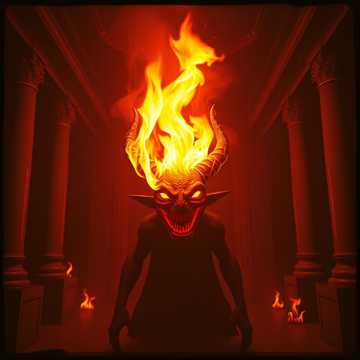
Epistula VIII – „De risu daemonis”
“On the Laughter of the Demon”
Fragment preserved on wax tablets hidden within the wall of a cistern. Discovered accidentally during archaeological work beneath a Roman basilica.
Marcus, whom I no longer fear to scandalize,
You said recently that the new religion is too gentle.
Love, humility, turning the other cheek…
Ah, Marcus, do not be naïve.
Religion does not exist merely to comfort.
It must govern.
And to govern effectively — it needs not only a God, but an Adversary.
A promise of paradise is not enough.
There must also be fear of something worse than life.
That is why we created infernum.
Not as a place.
As a tool.
Before, there was only Hades — shadow, memory, absence of light.
But shadow does not terrify.
We needed fire, sulfur, screaming, eternity.
Something that would make men obedient even in silence.
And so:
We built hell in the image of our prison.
We gave it a guardian — a demon.
Out of excess irony — once an angel.
And we gave him… laughter.
For only he who knows the truth laughs at those who do not.
The demon is not the one who rebels against God.
The demon is the one who knows the mechanism of religion from the inside.
And that is why he laughs.
Sometimes, when I hear priests describe the flames of hell,
that laughter rings in my ears.
Not because it exists.
But because it works.
It works better than the sword.
Better than the tax.
Because it lives inside a man.
And makes him judge himself, fear himself, silence himself, punish himself.
And thus we have a new miracle:
Self-discipline.
Self-surveillance.
Self-condemnation.
All of it… in the name of salvation.
Do you know, Marcus, whom the priests truly fear?
Not the pagans.
Not the heretics.
Only those who cease to be afraid.
Because a man who no longer fears hell
is a man who can no longer be ruled.
Vale in risu, si ausus es,
Gaius Aelius Verus
from an evening scented with incense,
on the steps between the temple and the prison
📜 Later annotation (13th century, ink tinged with soot):
„Do not read aloud. Do not copy. Do not show to those who confess.
Insert it among the penitential prayers — so they will not find it.”
Epistula IX – „De scriptoribus qui sciunt etiam multis”
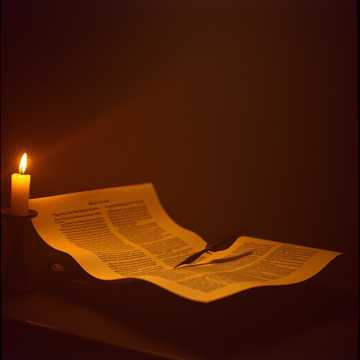
Epistula IX – „De scriptoribus qui sciunt etiam multis”
“On the Scribes Who Knew Too Much”
Scrap of a letter preserved on the inside of a codex binding, sewn in upside down, as if someone intended to hide it within the cover of another book.
Marcus, to whom I no longer need to explain,
Do you remember when the young scribe once asked us
whether God truly speaks through words?
I laughed then.
You — remained silent.
But now I think… he understood more than we did.
Because if God lives in the word —
then the greatest threat to power is not the sword.
It is the pen.
And the greatest enemy is not the heretic.
It is the one who can write the truth without hatred.
With love — but precisely.
We had many such men.
And we lost them all.
One wrote of a Jesus who laughed at the cross.
Another claimed the Resurrection was an inner awakening, not a historical fact.
Still another transcribed a prayer in the voice of a woman —
not to the Father, but to the Mother of Light.
All of them were buried in the margins.
Blurred.
Rewritten.
Replaced.
For the Church could not allow God to speak too privately.
Too quietly.
Too… humanly.
Truth, Marcus, cannot be democratic.
It must have a stamp, a seal, a scriptorium, a rite.
And so those who knew too much did not perish by fire.
But by correction.
By revision.
By silence.
Yet I know this.
I know that wherever someone once wrote the truth —
even on a clay tablet, a well wall, the inside of a sandal —
there the word survives.
Because not all ink can be erased.
And not all stories can be killed.
Vale inter literas quae sciant,
Gaius Aelius Verus
writing on his knee, by candlelight,
whose flame is just enough for one last sentence.
📜 Commentary of an anonymous monk (on the verso):
„This fragment appeared in a book no one had opened.
Perhaps it copied itself.
Perhaps someone wrote it in the night.
I do not know.
But the words are not mine — and I fear they may be someone else’s.”
Epistula X – „Epilogus: De theatro mun

Epistula X – „Epilogus: De theatro mundi”
“On the Theater of the World”
Parchment found in the alleged grave of Gaius, inside a clay sarcophagus. Lacking any seal, but signed in his own hand.
Marcus. My last letter, though not the first to you.
Everything I have written you was true.
And all of it — could be false.
Because truth, in our time, is form.
And form — is theater.
Religion is an art.
The priest — an actor.
Dogma — the script.
And the faithful — an audience that forgets it is watching.
I know what you’ll think.
That it was all a performance.
That we wrote the Gospels like plays for the masses.
That we invented God because we needed a prompter.
That we created Hell because the audience loves horror.
But you know what, Marcus?
Maybe I was wrong.
Maybe somewhere — among the falsified versions, the rewritten stories,
the parables turned into codes and edicts —
God was there.
Silent.
Present.
Trapped between words meant to use him.
Maybe he sits now at the edge of the stage and watches
as we perform his story — without him.
Maybe… he is silent.
Maybe he laughs.
Maybe he weeps.
But if one day you find me after death, Marcus,
and find these letters, and wish to publish them —
do not sign them with my name.
Sign them: The One Who Saw.
Because only the one who sees the theater
can leave the audience.
Vale.
Forever.
Gaius Aelius Verus
(in the shadow of the last light, in the moment when the theater goes quiet)
📜 Commentary of an unknown archivist (16th century):
„It is uncertain whether this letter truly belonged to Gaius.
Perhaps it is merely a play.
But if it is a play — it is too true.”